
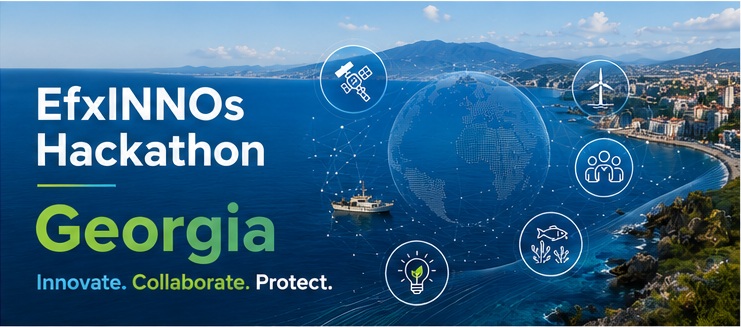
The Regional Hackathon in Georgia will bring together students, researchers, software developers, marine scientists, engineers, policy stakeholders, and young professionals to collaboratively develop innovative tools and applications based on the EfxINNOs project’s marine monitoring datasets and technologies. The event will focus on topics such as marine biodiversity mapping, automated seabed image analysis, marine litter detection, ecosystem health assessment, data visualization, and AI-driven environmental monitoring solutions. Participants will be encouraged to propose practical and scalable solutions addressing the environmental and socio-economic priorities of Georgia and the wider Black Sea region, while exchanging knowledge and best practices with experts from across the project consortium.
The Georgian Regional Hackathon will also serve as a preparatory platform for the Final EfxINNOs Hackathon, which will be hosted in Varna, Bulgaria. The event will support the development and refinement of innovative concepts and prototypes that may be further showcased during the Final Hackathon, where the most promising teams and solutions from all participating countries will come together. The Final Hackathon will provide a unique opportunity to strengthen cross-border collaboration, foster innovation, and promote advanced digital solutions that contribute to sustainable marine governance, ecosystem protection, and Blue Growth across the Black Sea Basin.
Tbilisi, Georgia
Note: The exact venue will be communicated directly to the selected participants.
10 –11 October, 2026
Preliminary Agenda – Day 1
10:00–11:00 | Registration & Welcome Coffee
Participant registration, welcome coffee, informal networking and arrival of participants.
11:00–11:20 | Official Opening and Welcome Remarks
Welcome by the host institution and introduction to the EfxINNOs project and the objectives of the Regional Hackathon.
11:20–11:50 | Meet the Participants – Icebreaker & Introductions
Short introductions of participants, mentors and experts to facilitate networking and interdisciplinary collaboration.
11:50–12:50 | Lecture Session I
The Black Sea Environment: Key Challenges, Marine Ecosystems and Monitoring Needs
12:50–13:50 | Lecture Session II
EfxINNOs Marine Monitoring Technologies and Data: Smart Buoys, AUVs and ROVs
13:50–14:50 | Lunch
14:50–15:50 | Lecture Session III
From Marine Data to Digital Solutions: Data Processing, Visualization, GIS and Environmental Indicators
15:50–16:50 | Lecture Session IV
AI and Innovation for Marine Monitoring, Ecosystem Protection and Sustainable Blue Economy
16:50–17:10 | Coffee & Snack Break
17:10–17:40 | Presentation of Hackathon Challenges and Working Rules
Presentation of the challenge areas, available datasets, expected outputs, mentoring process, evaluation approach and practical working arrangements.
17:40–18:20 | Team Formation and Challenge Selection
Participants form interdisciplinary teams of 3–5 members, select a challenge area and identify the problem they will address.
18:20–20:00 | Hackathon Working Session I – Problem Definition & Concept Development
Teams define the problem, identify target users and expected impact, explore available data and begin developing their solution concept.
20:00–21:00 | Dinner
21:00–23:00 | Hackathon Working Session II – Solution Development
Teams continue developing their concepts, prototypes, applications, visualization tools or decision-support solutions with support from mentors and experts.
23:00–23:30 | Late Dinner / Evening Meal
23:30 onwards | Overnight Hackathon Session
Teams continue working at their own pace throughout the night. Mentoring and technical support will be available according to the agreed schedule.
Throughout the evening and overnight: coffee, water, refreshments and snacks will be available for participants.
Preliminary Agenda – Day 2
09:00–10:00 | Breakfast
Breakfast for participants and informal networking.
10:00–12:30 | Hackathon Working Session III – Final Development
Teams continue developing and refining their solutions, prototypes, applications, visualization tools or decision-support systems. Mentors and experts provide final technical and scientific guidance.
12:30–13:00 | Finalization and Submission of Team Outputs
Teams finalize their solutions and prepare their presentations/pitches for the jury.
13:00–14:00 | Lunch & Arrival of the Jury
Lunch for participants. Arrival and registration of jury members, followed by a short briefing on the hackathon challenges, evaluation criteria and scoring procedure.
14:00–16:00 | Final Team Presentations & Q&A
Each team presents its solution to the jury, followed by questions and discussion.
16:00–16:30 | Jury Deliberation and Evaluation
The jury evaluates the presented solutions according to the established criteria and determines the winning teams.
16:30–17:00 | Coffee & Snack Break
Networking for participants while the final results are prepared.
17:00–17:30 | Awards Ceremony
Announcement of the winning teams and presentation of certificates and awards.
17:30–17:45 | Closing Remarks
Closing remarks, acknowledgement of participants, mentors, experts and jury members, and information on the next steps towards the Final EfxINNOs Hackathon in Varna, Bulgaria.
17:45 | Group Photo & Closing of the Georgian Regional Hackathon
🔹 Coastal and Marine Ecosystem Monitoring — biodiversity assessment and monitoring of environmental conditions and changes;
🔹 Marine Ecosystem Restoration — digital tools for identifying, prioritizing, and monitoring measures for the protection and restoration of vulnerable marine habitats;
🔹 Marine Data Processing and Visualization — interactive dashboards, GIS applications, web platforms, and other visualization tools;
🔹 Artificial Intelligence for Marine Monitoring — application of AI and Machine Learning methods for automated underwater image analysis, object detection, anomaly identification, habitat classification, and assessment of environmental changes;
🔹 Digital Solutions for Ocean and Marine Spatial Governance — tools supporting data-driven decision-making, marine spatial planning, and environmental policy;
🔹 Innovative Solutions for a Sustainable Blue Economy — technologies and digital services contributing to sustainable marine resource management, environmental protection, and Blue Growth in the Black Sea region.
Throughout the Hackathon, participants will have the opportunity to collaborate with specialists from different fields and project experts, work on real environmental challenges, and develop their ideas into practical and scalable solutions.
Join the EfxINNOs Regional Hackathon to collaborate with students, researchers, technology specialists and industry representatives in developing innovative solutions for real challenges facing the marine and coastal environment. Participants will gain practical experience, receive guidance from mentors, expand their professional network and present their ideas to an expert jury. All participants will receive certificates, while the winning team may have the opportunity to travel to Varna, Bulgaria, and participate in the Final EfxINNOs Hackathon.
- Applications are open to both individuals and groups. Participants will form teams of 3 members;
- Participants must be 18 years of age or older;
- Good knowledge of English is mandatory;
- Interdisciplinary teams bringing together participants from different academic and professional backgrounds are particularly encouraged.
💡 Programming experience is not mandatory for every participant. The Hackathon brings together environmental, technological, engineering, and socio-economic knowledge. What matters most is a good idea, willingness to work as part of a team, and an interest in the future of the Black Sea.
Participants should bring their own laptops.
⚠️Please note: Due to the format and rules of the Hackathon, participants will be required to remain at the event venue overnight and continue working on their solutions.
- The winning team will have a chance to travel to Varna, Bulgaria, and participate in the EfxINNOs Final Hackathon.
- Certificates will be provided
📌 To participate, please complete the registration form at the following link:
https://docs.google.com/forms/d/e/1FAIpQLSckemH5uHt9lUACVKn15JplZJlb103V0k6JB8jfr-I2G5ZPIg/viewform?usp=publish-editor
📌 Registration Deadline: 30 September 2026
Following the deadline, selected applicants will be notified within three days of acceptance to participate in the Hackathon.
Further logistical details will be communicated to the selected participants.
An independent jury will evaluate the solutions developed during the Regional Hackathon. Each team will present its solution, prototype, application, data-driven tool, or decision-support system, followed by a short Q&A session.
The maximum total score is 100 points.
1. Relevance to the Hackathon Challenges and Environmental Impact – 20 points
The solution should clearly address one or more of the EfxINNOs Hackathon challenge areas and respond to a relevant coastal or marine environmental problem.
The jury will consider:
- relevance to Black Sea coastal and marine challenges;
- potential contribution to marine ecosystem monitoring, protection or restoration;
- contribution to sustainable coastal and marine management;
- relevance to Georgia and/or the wider Black Sea region.
Maximum score: 20 points
2. Innovation and Creativity – 20 points
The solution should demonstrate an innovative approach to addressing the selected challenge.
The jury will consider:
- originality of the concept;
- innovative use of digital technologies, data, AI, GIS or other tools;
- creativity in solving the identified problem;
- added value compared with existing approaches.
Maximum score: 20 points
3. Use of Marine Monitoring Data and EfxINNOs Technologies – 15 points
The solution should demonstrate meaningful use or potential integration of marine monitoring data and/or technologies relevant to the EfxINNOs project.
The jury will consider:
- effective use of available marine monitoring datasets;
- integration or potential use of data generated by smart buoys, AUVs, ROVs or other monitoring technologies;
- appropriate interpretation and transformation of raw data into useful information.
Maximum score: 15 points
4. Technical Feasibility and Prototype Quality – 20 points
The proposed solution should be technically realistic and demonstrate a credible pathway towards implementation.
The jury will consider:
- technical feasibility;
- functionality and quality of the prototype or demonstrated concept;
- appropriateness of the selected technologies and methods;
- potential for further development and implementation.
A fully operational final product is not required; a well-developed prototype or proof of concept is sufficient.
Maximum score: 20 points
5. Scalability, Sustainability and Practical Application – 15 points
The solution should have potential for practical use and further development beyond the hackathon.
The jury will consider:
- potential for application in real-world conditions;
- scalability within Georgia and/or other Black Sea countries;
- sustainability and long-term usefulness;
- potential users and beneficiaries, including researchers, public authorities, policymakers, businesses or local communities.
Maximum score: 15 points
6. Presentation, Teamwork and Communication – 10 points
The team should clearly communicate the problem, proposed solution, methodology and expected impact.
The jury will consider:
- clarity and structure of the presentation;
- ability to explain the proposed solution to both technical and non-technical audiences;
- evidence of interdisciplinary teamwork;
- quality of responses during the jury Q&A.
Maximum score: 10 points
Scoring Summary
| Evaluation Criterion | Maximum Points |
| Relevance to Hackathon Challenges & Environmental Impact | 20 |
| Innovation & Creativity | 20 |
| Use of Marine Monitoring Data & EfxINNOs Technologies | 15 |
| Technical Feasibility & Prototype Quality | 20 |
| Scalability, Sustainability & Practical Application | 15 |
| Presentation, Teamwork & Communication | 10 |
| TOTAL | 100 |
Selection of Winners
Each jury member will evaluate the teams independently using the above criteria. The final score of each team will be calculated as the average of the scores awarded by all jury members.
Teams will be ranked according to their final scores, and the highest-scoring teams will be selected as the winners of the Georgian Regional Hackathon.
In the event of a tie, priority will be given to the team receiving the higher combined score for Innovation and Creativity and Relevance to the Hackathon Challenges and Environmental Impact.
Participants will be introduced to the available resources and datasets on site.
Ketevan Kupatadze: Ketevan_kupatadze@iliauni.edu.ge
Tamar Edisherashvili: tamari.edisherashvili@iliauni.edu.ge